
IBM’s transition from the traditional Processor Value Unit (PVU) licensing model to the Virtual Processor Core (VPC) model represents a fundamental shift in how its middleware and hybrid cloud software is licensed. For CIOs, this change is not simply an administrative matter—it has direct implications on budget forecasting, architectural decisions, audit risk, and digital transformation roadmaps.
PVU licensing, a staple of IBM’s pricing for decades, was tied to physical and virtual core capacity, adjusted by processor type. It required meticulous tracking through IBM’s License Metric Tool (ILMT) for sub-capacity compliance. The VPC model, designed to align with containerized and cloud-native environments, simplifies entitlement management but introduces new considerations in terms of capacity planning and workload distribution.
This playbook equips CIOs to navigate the transition with a strategic lens, ensuring both cost optimization and compliance.
Market Trends and Impact
- IBM is aggressively bundling middleware products into Cloud Paks, all of which use VPC metrics.
- VPC licensing aligns with OpenShift and containerized deployments, which now dominate IBM’s modernization pitch.
- ILMT remains relevant, but Red Hat Advanced Cluster Management (ACM) and other tools are gaining prominence for VPC tracking.
- Enterprises with legacy PVU entitlements face renewal decisions that may involve forced migration to VPC.
According to Miro Consulting, “Most clients do not realize that a shift to VPC will reset their license metric, and without optimization, this can result in a 10-20% cost increase.”
Understanding the Models: PVU vs VPC
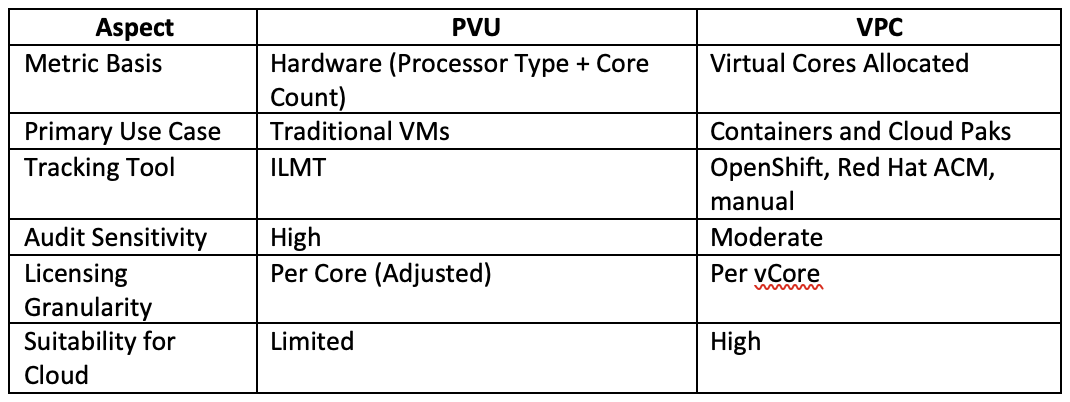
PVU (Processor Value Unit)
- Licensing tied to hardware characteristics (core type and count).
- Requires ILMT for sub-capacity compliance.
- Commonly used in traditional virtualized environments (VMware, Hyper-V).
- Subject to audit based on physical deployment footprint.
VPC (Virtual Processor Core)
- Licensing based on the number of virtual cores assigned to a containerized workload.
- Common in IBM Cloud Paks running on Red Hat OpenShift.
- Supports dynamic scaling but requires accurate capacity allocation tracking.
- Simplifies some aspects of entitlement but complicates cost predictability if not governed.
Key Differences CIOs Must Understand
Practical Implications of the Transition
1. Renewals Will Be Bundled
IBM increasingly bundles renewals of WebSphere, MQ, and IIB into Cloud Paks, making the move to VPC unavoidable for many customers. CIOs should proactively model cost scenarios for renewal cycles and avoid surprises.
2. Existing PVU Investments Are Not Always Transferable
While IBM may offer VPC entitlements at a discount during transitions, PVU entitlements do not automatically convert. CIOs should review entitlements and negotiate conversion ratios.
3. Cloud Pak Introduces Value but Requires Oversight
Cloud Pak bundles allow broader usage flexibility (e.g., using WebSphere, MQ, and App Connect under a single entitlement), but without governance, VPC consumption can balloon. Usage metering is critical.
4. New Tooling Requirements
CIOs must equip their teams with VPC-compatible tools or extend existing ILMT monitoring to containerized environments. Red Hat ACM and tools integrated with OpenShift are central to VPC tracking.
5. Budget Forecasting Must Be Redefined
VPC licensing can lead to unpredictable costs in dynamic environments. Capacity capping and workload right-sizing are essential.
Strategic Transition Framework for CIOs
Phase 1: Assessment and Mapping
- Inventory all PVU-based deployments.
- Map workloads to Cloud Pak equivalents.
- Identify opportunities for workload consolidation under VPC.
Phase 2: Cost Modeling and Risk Assessment
- Build cost models comparing PVU and VPC pricing.
- Identify cost drivers such as over-allocated vCores.
- Quantify audit risk for legacy deployments.
Phase 3: Tooling and Compliance Readiness
- Extend ILMT where applicable.
- Deploy or configure OpenShift metering for VPC usage.
- Set up alerting for vCore thresholds and compliance boundaries.
Phase 4: Contract Strategy and Negotiation
- Engage IBM with modeled scenarios.
- Seek favorable VPC conversion ratios.
- Request audit waivers or transition periods as part of renewal.
Phase 5: Governance and Optimization
- Implement continuous monitoring.
- Align DevOps and infrastructure teams on vCore consumption discipline.
- Use reporting to enforce license-aware deployments.
Key Statistics
- 60% of IBM customers will shift to VPC by end of 2025 (Gartner).
- Clients report 10-20% cost increases if VPC transitions are not optimized (Miro Consulting).
- 75% of Cloud Pak adopters underutilize their entitlements in year one.
- Enterprises that implement VPC governance frameworks reduce overruns by 32%.
Conclusion
The transition from PVU to VPC licensing marks a pivotal moment for IBM customers. While it reflects a modernization of IBM’s commercial model to suit hybrid cloud realities, it introduces new challenges in cost control, entitlement tracking, and governance.
For CIOs, success lies in preparation: understanding the licensing mechanics, building the right tooling ecosystem, modelling costs, and negotiating strategically. This playbook offers a structured path to manage the transition, minimize disruption, and turn licensing reform into a competitive advantage.